After an injury performing Lived Fiction on tour last year in Switzerland, company dancer Emily reflects on her journey post injury, recovery and the support she received.
Listen to this blog read by Emily
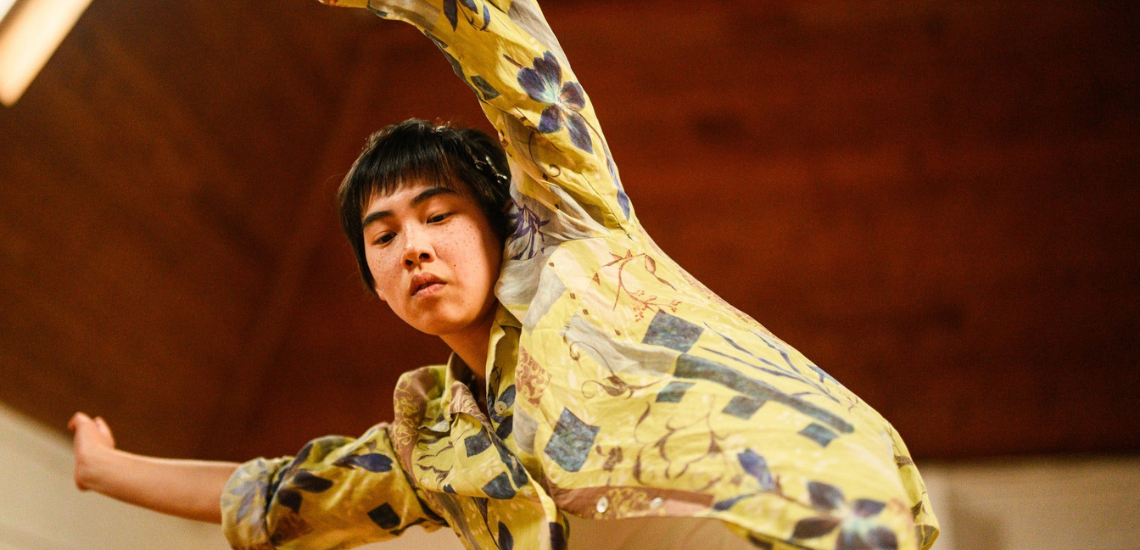
Emily dancing, she reaches both arms upwards and looks down towards the camera. Emily is an East-Asian woman with short straight black hair, she wears a pale yellow shirt with faded dark blue floral patterns.
Diary of an Unexpected Break (Quite literally!)
The day after - May 2025
Coming back from A&E in Lugano, Switzerland with a broken foot, torn ankle ligaments, a boot and crutches was very much not on my bingo card. Until that moment, I’d never experienced an injury that fully stopped me from dancing. Before the show I felt strong and grounded which made it harder to understand how quickly things changed.
Unforeseen accidents are strange like that. On stage in front of a live audience adrenaline kicks in. My brain went into problem solving mode: Can I keep going? How do I adapt? Where’s my nearest exit? I knew my body well enough to sense this was serious, even when people told me to “stay positive.” In that moment, listening to my body mattered more than forced optimism.
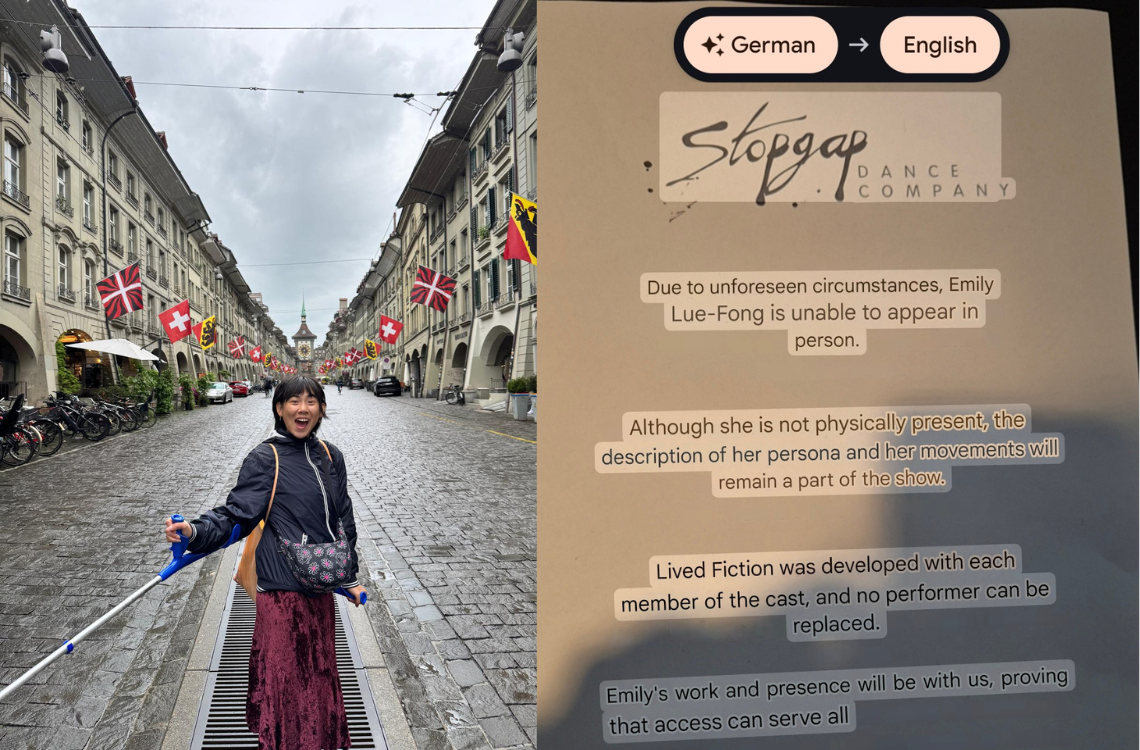
Left: Emily in Paris? No, Emily in Bern, rocking the crutches and still engaging in some tour tourism. Right: A German to English translation of a sign at one of our performances in Switzerland, which shares the news that Emily won't be performing in person, but through creative access her presence will still be felt.
Day 5
Getting injured on tour in another country added layers we as a company didn’t prepare for, even with backup options. Those Plan B’s took the pressure off, but it was still hard watching the team continue without me, there was literally an “Emily shaped” gap in the formations. Even though I wasn’t physically present, my role was still felt. The audio descriptions and creative captions played as usual so my movement and persona lived on through creative access. It was a quiet reminder that inclusive practice strengthens the work for everyone. Most importantly, the team never made me feel like a burden, they supported and included me in every way.
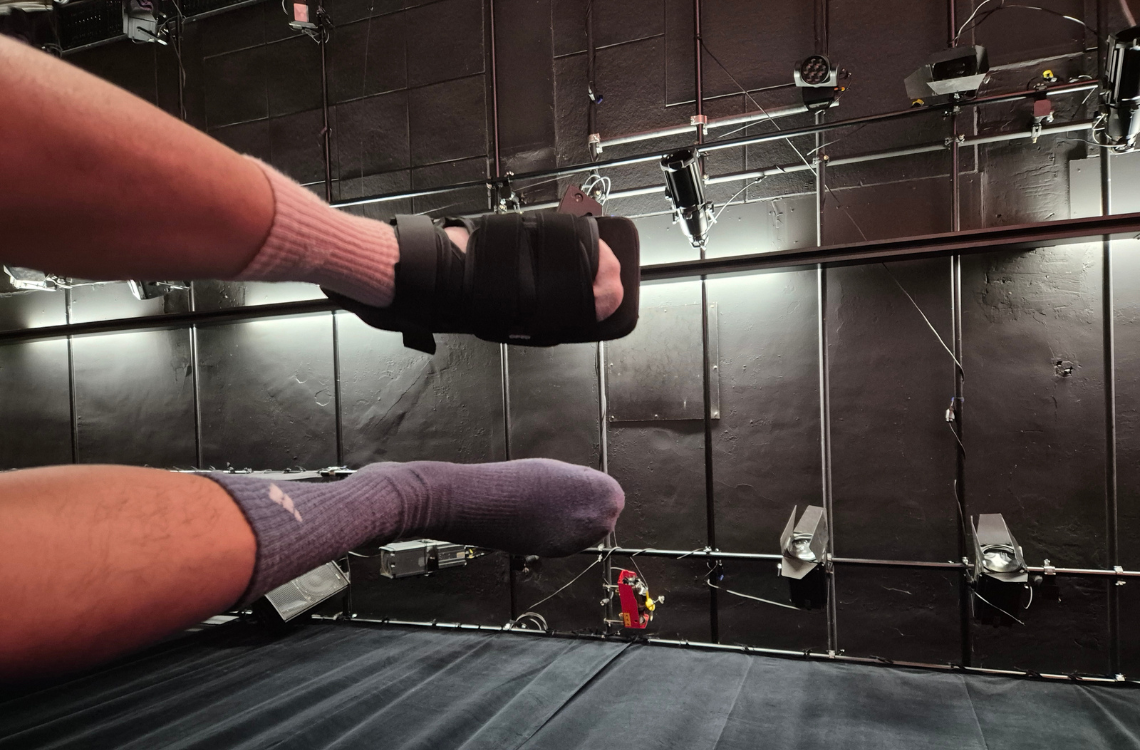
Emily's view from the floor: Feet elevated to help with bloodflow, odd socks and a boot contraption from the hospital on her left foot. A black ceiling crisscrossed with lighting bars and theatre lights.
Two weeks - June
On reflection, this injury forced a pause. I went straight from training into company life, so I’d never had time to process the intense years, or to properly stop. I reconnected with things I’d neglected: books, shows, TV recommendations, and friends visited when I couldn’t drive or get out much, and that meant more than they probably realised.
I also made the decision to delete social media for my mental health. Seeing endless highlights of people dancing and “thriving” was tough, so stepping away helped me breathe.
Two months - July
I’m a driven person, so once the boot came off, I was ready to rehab, hard. It was summer, physios were on holiday, and finding a specialist was harder than expected. The NHS was helpful in providing basic physio and hydrotherapy – me and three middle-aged women doing our exercises in the pool. It wasn’t at all glamorous, but it was progress.
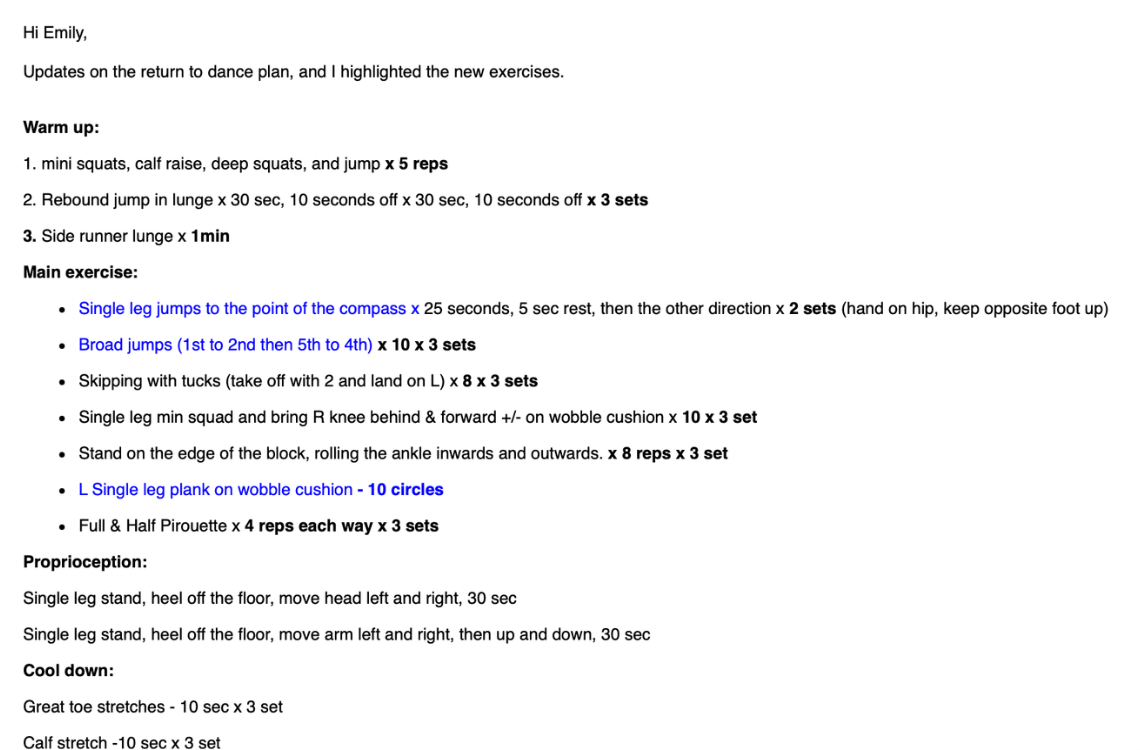
An email from Emily's physio with exercises for her rehabilitation.
Five months - October
I was advised to look into dance-specific support and applied to the Dance Professionals Fund, which connected me with BAPAM (a specialised performing arts health organisation) and eventually a specialist physio – shout out to Beth from Flexibility Matters! I received six fully funded sessions, which took a huge burden off my mind.
Finding a specialist took over three months, a period filled with frustration and anxiety, especially after being signed off to return to dancing earlier in the summer. It can feel incredibly isolating having to research, email, and call multiple organisations while you’re already dealing with injury. Access to dance healthcare is something many professional dancers struggle with, and it’s a gap that deserves far more attention.
If I could offer one piece of advice: definitely look. Support is out there, and even though the process can be slow, it makes a real difference.
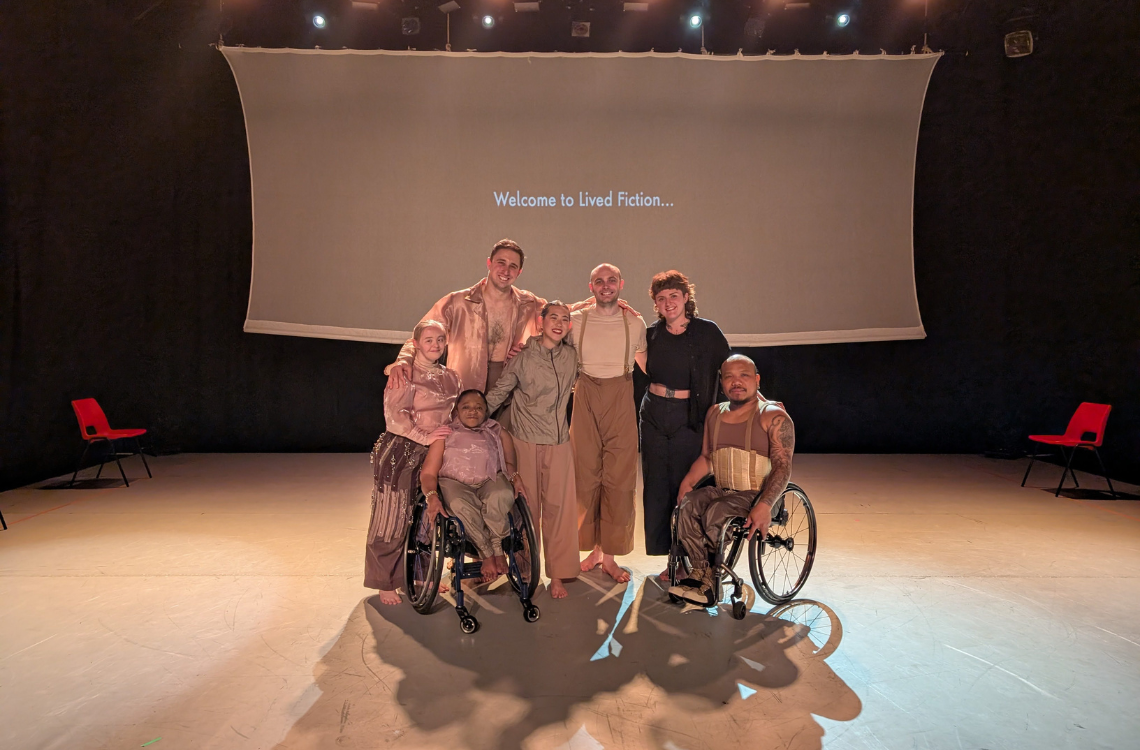
Emily with the Lived Fiction team before a show, behind them the creative captions read 'Welcome to Lived Fiction'.
Present
Following a rehabilitation plan focused on regaining full range of motion, strength, jumps, balance etc., I’m back in the studio! This has allowed me to make consistent progress and given me the tools to continue a self-managed programme. My ongoing goal is to be performance-ready for shows at Sadler’s Wells East and to know that all the hard work I’ve put in will be the greatest payoff – alongside a good show!
Interestingly, while I was away, I didn’t miss dance as much as I expected. But watching rehearsals and seeing people move and teach reignited the fire, determination, and quiet certainty that I’ll return, changed, but still me.