
Listen to this blog
Our newest company dancer Lili joined Stopgap straight from university to originate a role in Nadenh Poan’s RO-TES-រទេះ, and in her first blog for the company, she’s refreshingly candid about what the past year has involved: the nerves of being the newest and youngest in the room, the work of embodying an element as bold as fire, and what it means to tour as a deaf dancer whose disability is neither hidden nor the whole story.
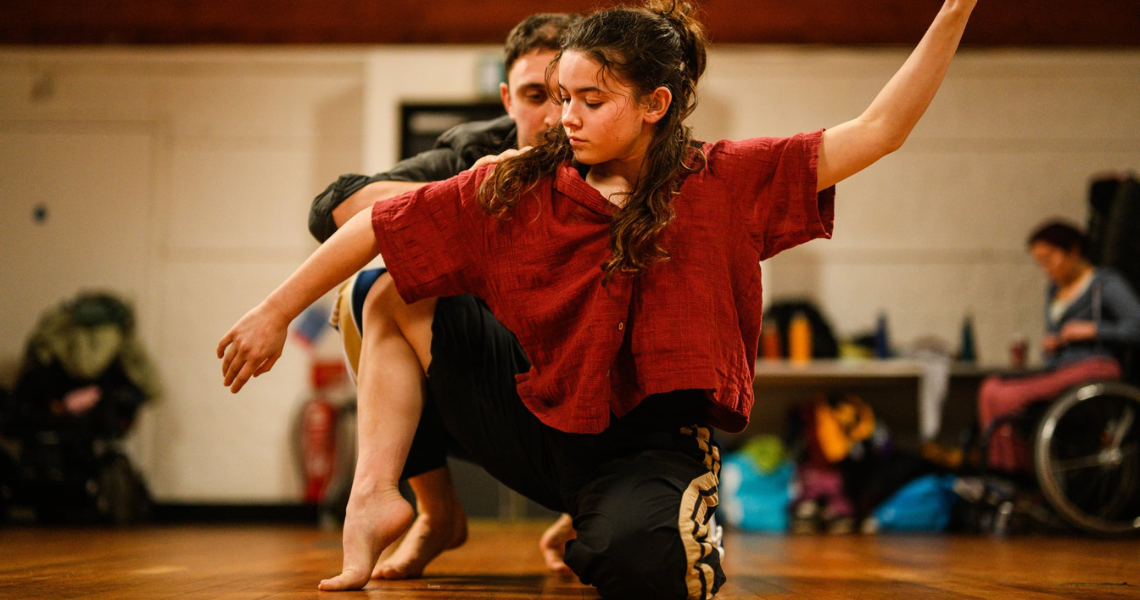
Lili, a white deaf dancer, dances low to the ground in a rehearsal studio, one knee bent beneath her and the other leg extended to the side, foot flexed. Her right arm sweeps upward, fingers relaxed, while a fellow dancer supports her from behind, his hand steadying her shoulder.
For those of you who don’t know me, or even those of you who do, I am Lili MC, a standing white dancer with brown hair, brown eyes and brown hearing aids. I joined Stopgap in March of 2025 as a deaf dancer for the creation of Nadenh Poan’s RO-TES-រទេះ. Currently in between my second tour of RO-TES-រទេះ, I have written this blog to note the transition between university and professional life as well as all the changes and lessons I have learnt since starting at Stopgap.
In the room
RO-TES-រទេះ in Khmer stands for “wagon”, the transportation device used across the globe, and is also the meaning of the piece we are currently touring. A performance exploring journeys: both individual and collective, for the dancers or audience, and for people that have come from near or far.
So what was mine?
My journey within RO-TES-រទេះ was, and still is, one that is ever-changing as I learn and re-learn what it means to perform it. There were also challenges and joys with the creation of the piece. Some that have changed my view on how I approach dance and others that have changed me too, for better I hope.
A particularly challenging journey I went through during the creation of RO-TES-រទេះ was understanding where I stood in it. A piece centered around unity and community is difficult when you are unsure on where your own feet are placed. In a new company, with new people, and dancers that had known each other for years… and me. For one it was difficult not to wonder if I was unfit for the part. On the one hand, I trusted my teachers and Lucy Bennett (Co-Artistic Director) who had seen me perform in my third year of university and deemed me right for the part. On the other, I was in a room of dancers that had toured multiple pieces and my not-yet-graduated self was rather intimidated. But a quote by Gillynne Dasco reassured me: “At least you are in the room.” And I was in the room.
That was the start of my journey with RO-TES-រទេះ. One full of nerves, excitement and a desire to do my job well.
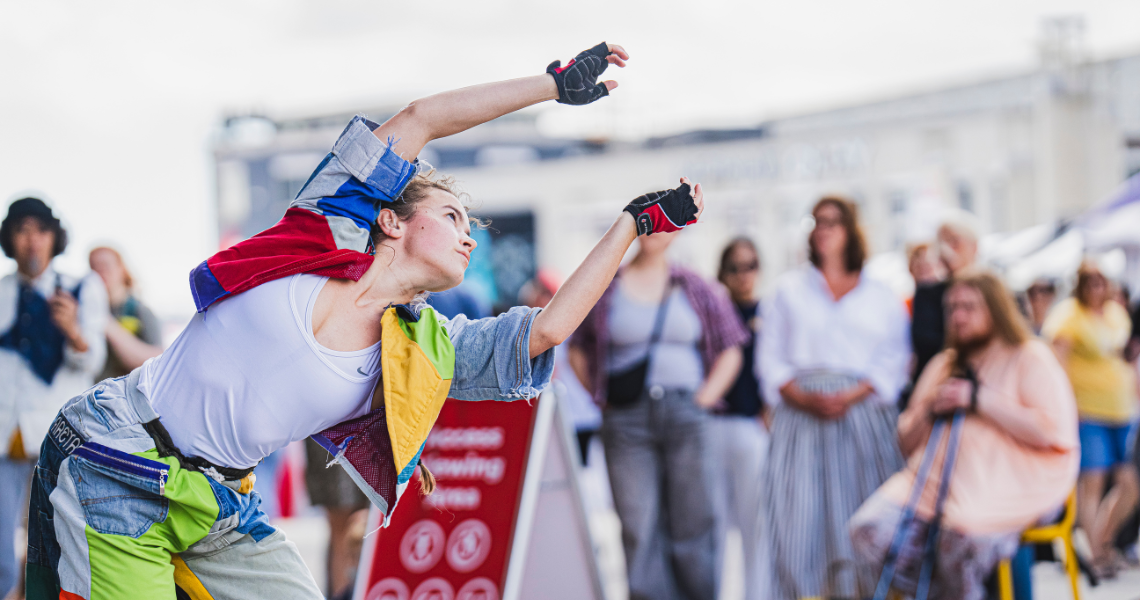
Lili performing outdoors, leaning forward with both arms extended overhead in fingerless gloves, wearing a colourful patchwork costume of denim, red, blue, yellow and green fabric over a white vest top. She dances with a crowd of onlookers gathered behind her.
My story to tell
Perhaps the most important element of RO-TES-រទេះ is the story we tell during it. Now these all vary, from dancer to dancer, and day to day. It can change every time if we like. That is one of the great things about a piece centered around people. The problem was, for the first few months, I had no idea what it was that I wanted to say. What would people want to hear from me? Did I have anything interesting at all to share? Truthfully I am still unsure if it’s interesting but I do now have my story. The message I tell in every performance to the ones that are happy to listen.
I am deaf, and rather happily so. I enjoy the fact that I can sleep soundly through a storm. That if the noise is too loud in a certain place I have the rare option to simply avoid that sensation altogether. I think it is very cool that I can tune into sound through vibrations, and enjoy having conversations with people about it. RO-TES-រទេះ is exactly that, a conversation – entirely through movement – from dancer to audience and back again. Fuelled by intrigue and curiosity, both my own and others, deafness has been the centre of my conversations with people for a long time. Though I have always had a positive outlook on my disability and always intend to, a change has been spurred recently and a part of that change comes from RO-TES-រទេះ.
Growing up I was the only deaf person in spaces, so it naturally became the way to differentiate me from other people. As young people we are labelled the “smart” or the “sporty” one, it is easy to see the subtle harm that comes from being labelled the “deaf” one in a group. The change came from arriving into the studio and that no longer being my distinction. In Stopgap, I am still deaf but it is no longer my defining characteristic. In the piece, my audio description tells the audience “I have brown hair, brown eyes, brown hearing aids and I enjoy playing with acrobatic movement.” My deafness is no longer the centrepiece of my personality or description but an integrated element of it. A correct percentage of value is placed on my disability rather than a large and overly exaggerated portion. Though I personally have never exaggerated my deafness, or allowed it to be the one defining thing about me, it is refreshing and empowering to be in a space that encourages a comfortable amount of emphasis to be placed on it. No complete disregard to my deafness or total abandonment for anything else that I contain, simply that I am a great deal many of things, and deaf is one of them. The creation of RO-TES-រទេះ was far more than the creation of an important piece to me. It was a period of time where I was taught – by some of the most able to teach it – the lesson in unity in uniqueness.
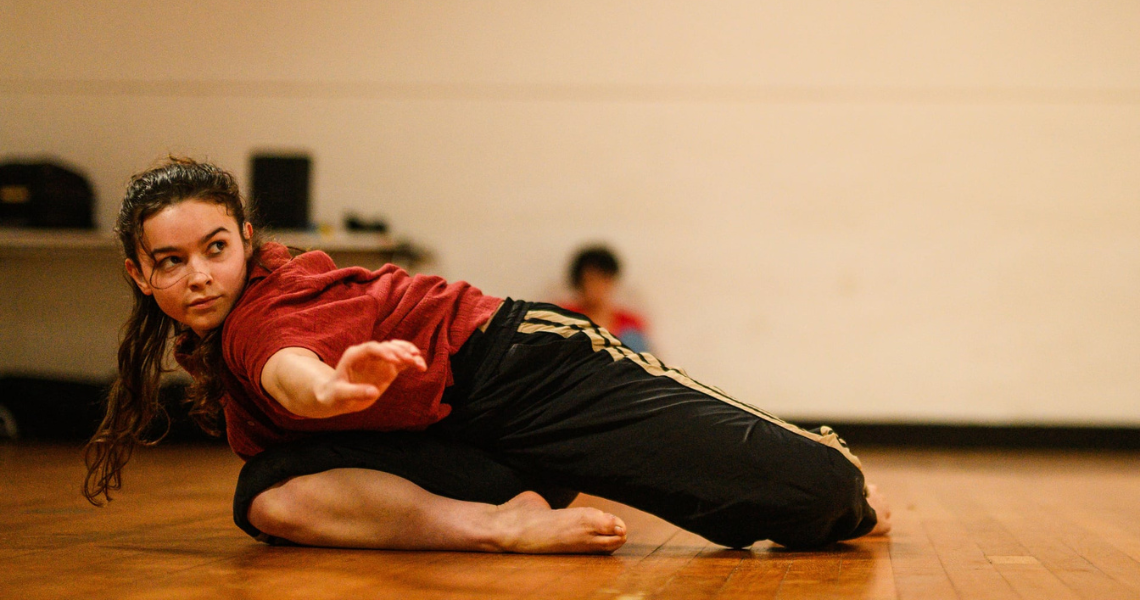
Lili during floor-work, she leans low to the studio floor, legs curled beneath her, leaning to the left and glancing over her shoulder as she stretches her right arm forward.
A lesson in confidence
Before the most important lesson however, I had to go through a lesson in confidence. At this stage, I am still firmly in the middle of my journey, perhaps even still closer to the beginning than I am to the end. Even still, I have seen myself through a season of change since the start of creation and am now processing just how that has come about. In all pieces there are multiple elements within it, some more physical and many under the surface. Within RO-TES-រទេះ all the dancers are also assigned an element of their own.
My element is fire. An element of brazen colour, almost mischievous quality and entirely confident in its movements. It is important to note that I am not the most confident person in general and often refer to myself as an introvert and no one disagrees. Immediately I knew work would have to be done to get myself on par with the personality of fire. Abi Mortimer’s “Get out of your own way” (Co-founder of Lila Dance as well as lecturer at Chichester University) and Lucy Bennett’s “Make the solo your own” became regular mantras in my mind throughout the process – whilst staring at images of fire and trying to embody it as best I could. It is still, more than a year later, my area of biggest improvement while simultaneously being my area of biggest improvement still to come. While I maintain the view that outdoor work is focused on seeing more of the person dancing than a dancer, I have to admit some acting when performing as fire and the persona that it requires. I am, on the whole, very excited to see how I portray fire after this next round of tour dates.
One thing I was taught immediately about specifically touring outdoors was the “person” side of it. I was told that you can practice hundreds of times but when performing outdoors there is always something new that happens that you did not prepare for. As a seasoned perfectionist and one of those dancers who cringes when remembering a mistake they made on a show four years ago, this was a rather scary pill to swallow. I am glad to say that I have now digested the pill and come to appreciate those moments. It is something I only learnt once touring RO-TES-រទេះ and continue to learn with every moment that I hesitate to grimace at and choose instead to lean into it.
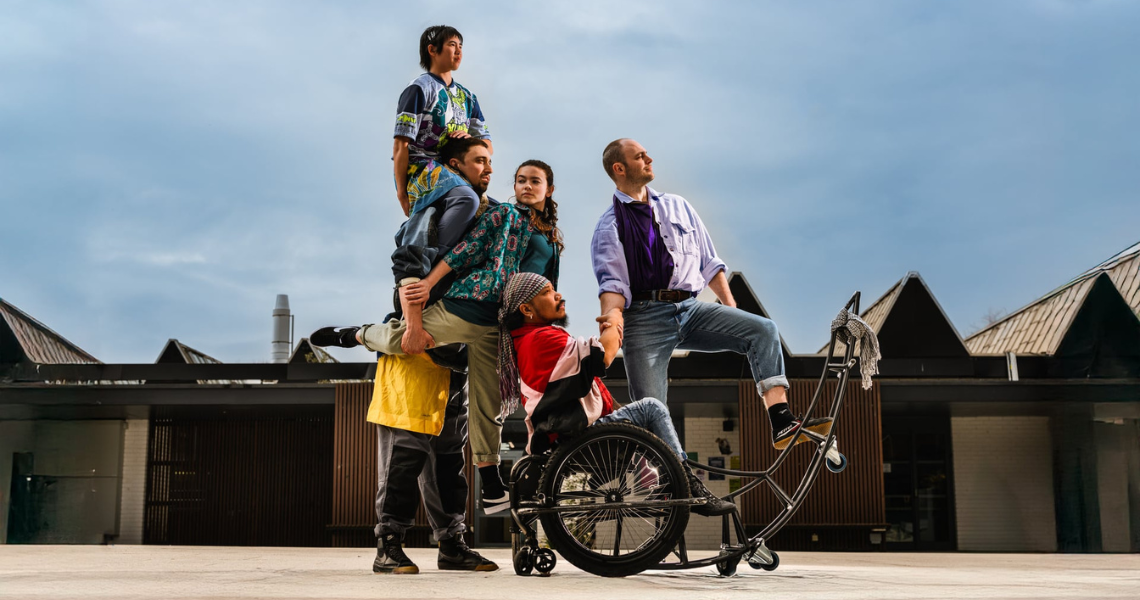
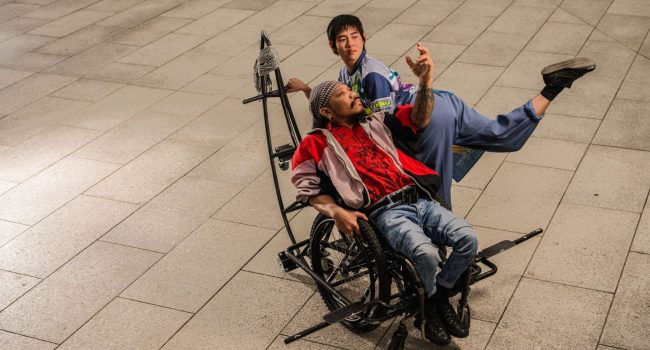
A group of five dancers outside. Gathered around Nadenh in his Ro-Tes, an adapted manual wheelchair with a long metal tail that curves upwards from his chair. They all connect to Nadenh, the Ro-Tes and one another, it gives the impression of a loaded wagon - looking forwards and ready to set off on an adventure.
Unity in Uniqueness
Now we are onto my personal favourite: “Lessons in Unity in Uniqueness” It’s a lovely phrase but what does it mean?
The biggest journey that I have undertaken since the creation of RO-TES-រទេះ is the one taken by us all as a society. To understand better and accommodate more for people like myself that the world was not originally built for.
We are all, in one way or another, different. Each with our own experiences and brilliances. Unity in Uniqueness presented itself first to me when I finished a run of RO-TES-រទេះ and understood my place in it, in the message I wanted to say when performing it. It now presents itself in everyday life. In people from all walks of life. In disabled people and non. In neurotypical and neurodivergent. It is the collaboration of us all to make a society that suits all, that holds a space for all. To utilise the uniqueness of everyone and find unity within it. Stopgap is proof that this collaboration exists. That “creating a society that fits all” works. The last frame of RO-TES-រទេះ when Nadenh is held aloft on his RO-TES-រទេះ, Emily and I are on either side guided by Chris and Jannick is my image of unity in uniqueness. An image only possible because of our differences. That is the journey of RO-TES-រទេះ for me.
Discover RO-TES-រទេះ
After the international success of Frock, Stopgap returns with their latest outdoor show RO-TES-រទេះ. Marking Disabled artist Nadenh Poan's choreographic debut in collaboration with the company's world-class dancers.
Find out more