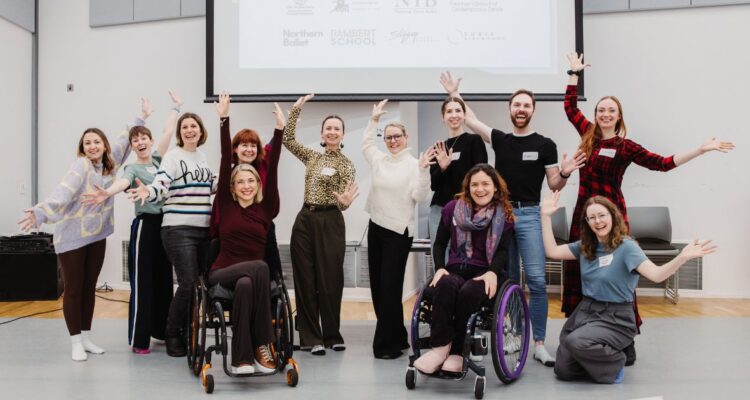
November 2025 saw the launch of the Access Ballet Collective (ABC) – a group whose goal is to explore how to make ballet more accessible and equitable. Its members are Ballet Cymru, Birmingham Royal Ballet, The British Ballet Organisation, English National Ballet, JPM Productions, Kate Stanforth Academy of Arts, National Youth Ballet, Northern School of Contemporary Dance, Northern Ballet, Rambert School, Stopgap Dance Company and Suzie Birchwood.
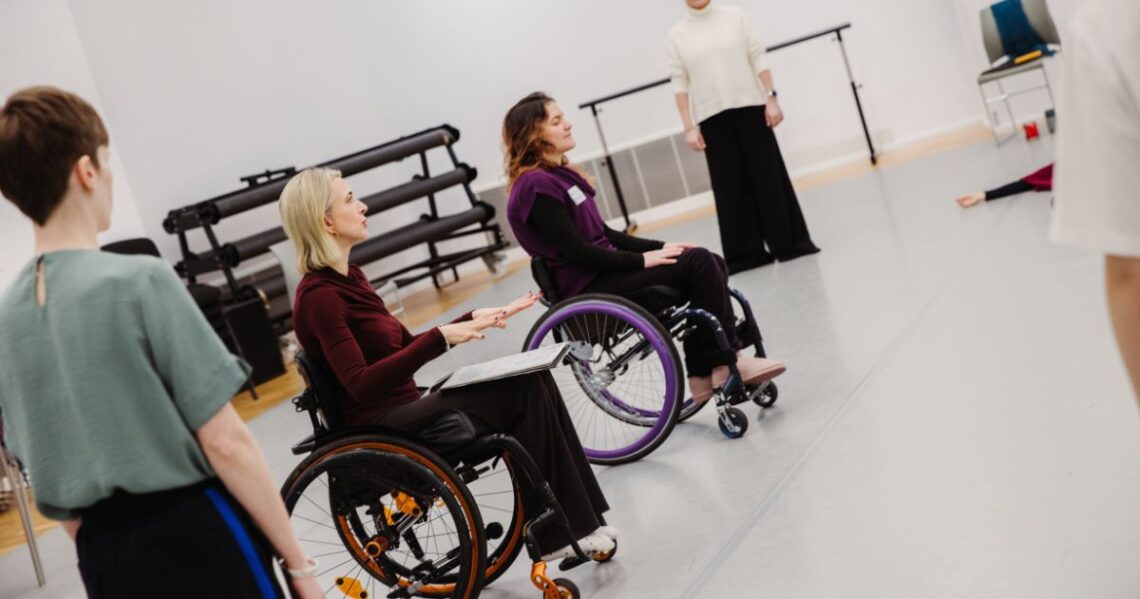
Suzie sharing practice at the ABC's first meeting. Suzie sits in her wheelchair, clipboard on lap and hands gesturing, beside her Laura Jones from Stopgap in her wheelchair has her eyes closed. Other ABC members stand and lie around the space. Photo by Maria Polodeanu, courtesy of Birmingham Royal Ballet.
The ABC met in January and here are some thoughts from the chair of the first meeting, Suzie Birchwood…
The first meeting of the ABC felt like stepping into a room that had been quietly building momentum for years, a room full of people already doing the hard, careful work of widening access to ballet, and ready to do it together.
I opened the day by acknowledging something we don’t say often enough: just showing up to this kind of work is a contribution.
Time, energy, and resources are stretched across the sector. Access work is frequently expected to be both visionary and deliverable, often with too little funding, too little time, and too much pressure to “prove” itself. This network exists because so many people have already been doing the work anyway, often at the edges of institutions, programmes, and traditions.
And that idea – the edges – became a quiet thread throughout the day.
Ballet is at a moment of pause and possibility. Ballet is no longer being asked simply to open its doors wider, but to question who those doors were built for in the first place. For many years, access work has existed as projects, pilots, or exceptions, while the core of the form remained largely unchanged.
That work has been important, and many people in the room have led it with care and courage. But we also know that there is so more to do.
What we are being asked to build now is different: a culture where more people truly belong, where disabled people, people with lived experience of barriers, and communities historically excluded are not visitors, but shapers.
Stopgap Dance Company launched the ABC as a sector-wide collaboration rooted in the idea that access is not an “add-on,” but a creative driver, and that lasting change will only happen if organisations learn together, share responsibility, and take practical action across time.
The first gathering brought that intention into the room: in person and online, across different roles, organisations, and approaches, but aligned by a shared urgency.
An overview of the day
The day was designed as a working space rather than a showcase: a chance to connect the dots between separate strands of access activity, and to create the beginnings of a shared direction.
We started by establishing how we wanted to work together: with generosity, with respect for different organisational contexts, and with a commitment to listening as much as speaking. Throughout the day, we returned to a central question: what does ballet need to become, if it is to be genuinely accessible – not as a special project, but as a normal way of being?
A key moment in the day was hearing from Laura Jones, Co-Artistic Director at Stopgap, who shared the Beyond Barriers research. This work grounded the room in lived experience and the real conditions that shape who can take part, and it is central to informing dance work planned for the future. It offered not just context, but direction: a reminder that accessibility is not an abstract ideal, but something that must be designed into structures, planning, and decision-making from the start.
From there, the focus moved between two essential areas:
- Naming the challenges the sector is facing (systems, traditions, funding, training pipelines, expectations of the “ideal” ballet body)
- Identifying what is already working, the shifts that have happened, even slightly, so that progress is visible, shareable, and harder to dismiss
Just as importantly, we spent time considering what meaningful participation in the network looks like. The tone was pragmatic: people want collaboration that is purposeful, not performative; structured, not burdensome; and sustained beyond a single meeting.
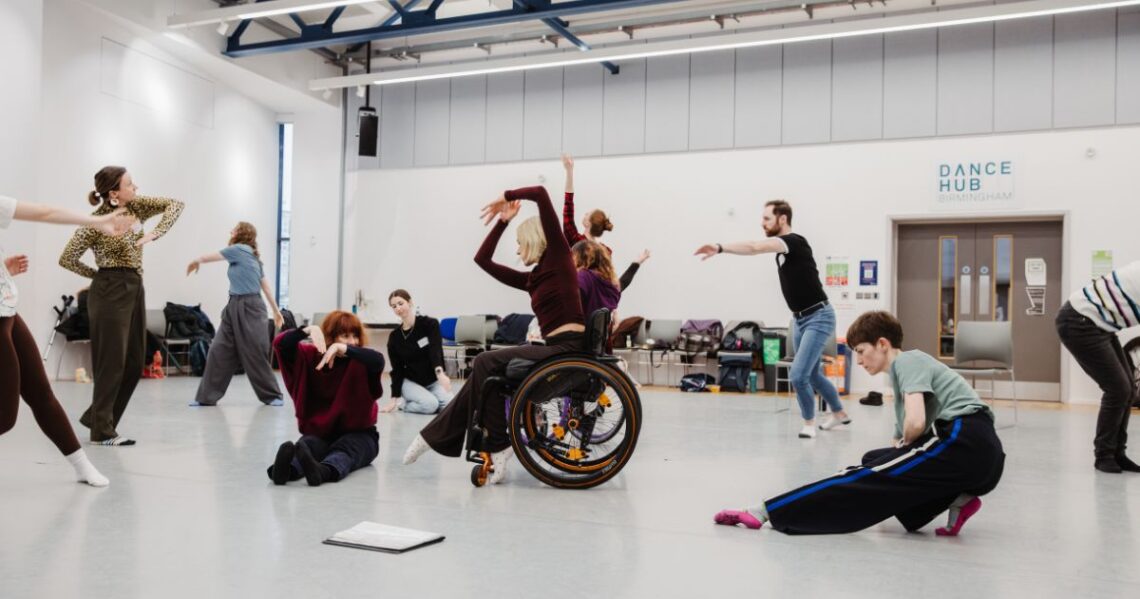
In the centre of a grey dance studio, Suzie dances in her manual wheelchair arms raised high. Around her, other dancers move around the space, up high and from the floor. Photo by Maria Polodeanu, courtesy of Birmingham Royal Ballet.
The aims of the ABC
The meeting clarified that this Collective is not about replacing anyone’s existing work. It exists to strengthen it, to make sure learning isn’t locked inside individual organisations, and to help move access from the margins into the centre of how ballet thinks and operates.
The shared aims that surfaced across the day can be summarised as:
- To connect and coordinate: building relationships across organisations so access work is less isolated and more cumulative
- To shift the culture of ballet: moving from “inviting people in” to redesigning conditions of belonging
- To centre lived experience: keeping disabled perspectives and the realities of barriers as a guiding force, not an afterthought
- To treat access as artistic and structural: not only about ramps or adjustments, but about authorship, aesthetics, training, opportunity, and who gets to shape the form
- To build collective momentum: sharing successes, naming obstacles, and creating a stronger joint case for change across the sector
What we want to achieve
If the day proved anything, it’s that ballet is not short on care, intelligence, or will. What’s often missing is connectedness, a way to stop reinventing the wheel, stop working in isolation, and stop treating access as exceptional.
This first meeting wasn’t about fixing ballet in one day. It was about committing to the long work of change together: making access a shared responsibility, and ensuring that when we speak about excellence, we are no longer speaking in a way that excludes.
To close, I returned to something that sat beneath every conversation: this network doesn’t replace existing steering groups or individual missions, it supports them, strengthens them, and connects them. In a sector that often forces organisations to operate as islands, the ABC is a commitment to seeing each other’s work, respecting it, and lifting it up whenever we speak about progress.
What you are doing matters, and together, it matters more.