
For Senior Dance Artist Christian, teaching in London was a bucket list item. In this blog, he reflects on co-leading a week of inclusive professional classes at Independent Dance alongside fellow artist Nadenh Poan — and what it means for Stopgap, for Disabled artists, and for the wider dance community.
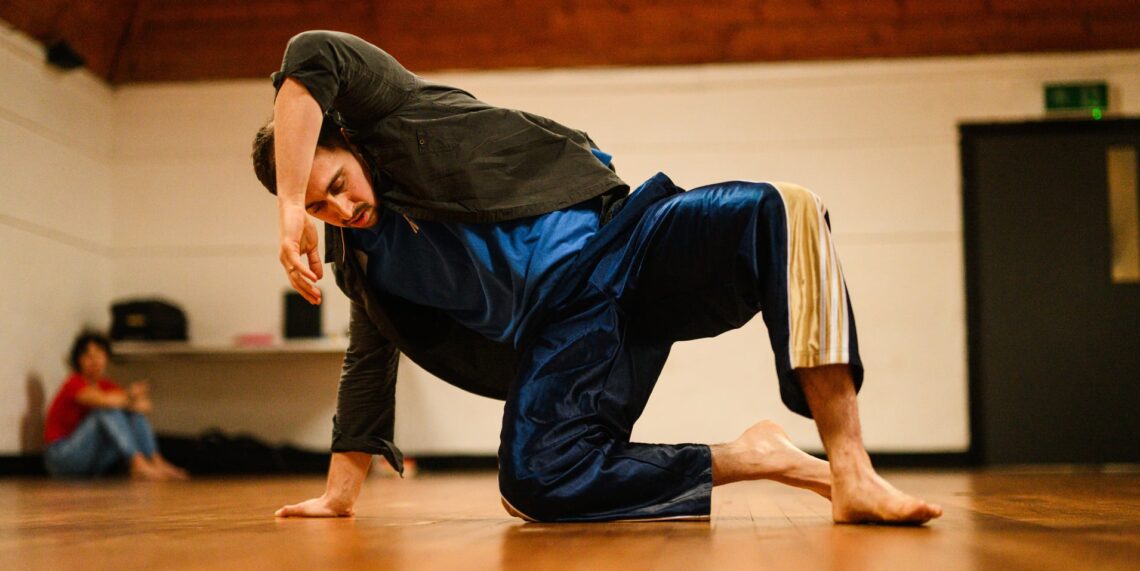
Christian, a tall white man with short dark hair, crouches as he shifts along the floor. He leans into one hand and holds his other arm above his head.
Listen to Christian read this blog
Hey everyone, I’m Christian, I am a Senior Dance Artist and Head of Artist Development at Stopgap and recently I co-led a week of professional classes at Independent Dance with fellow Senior Dance Artist, wheelchair dancer and choreographer Nadenh.
Together we developed the class over a few weeks, we shared it during the production week of outdoor work RO-TES-រទេះ and got lots of useful feedback. Beforehand, we spent time investigating a range of translations for our movement ideas and fine tuned the content before we took it to London. When making material for our class, we always like to consider what is useful and how we can give people an element of challenge.
Sharing our practice
We must acknowledge that the opportunity for us to lead our inclusive professional class in London is a very significant step for Stopgap. Immediately we felt welcomed, supported and encouraged which led us to be able to pursue our best teaching work throughout the work. With the experience Stopgap has within inclusive dance, it is vital that we share this with the wider community and offer these opportunities for disabled dancers to be taught by disabled artists and non disabled allies. Opportunities to share learnings from working within an equitable culture for over a decade.
A conversation we had during the week mentioned having never been taught by a wheelchair dancer before. This highlights the importance of having the presence of outstanding disabled artists leading the way in supporting other disabled artists, giving them opportunities to learn and develop their skills.
It’s also about having the understanding that lives are busy; people must be able to grab the opportunities when and where they can and having new people every day meant that we could evolve the format we designed for the class and as we became more confident throughout the week, the content developed.
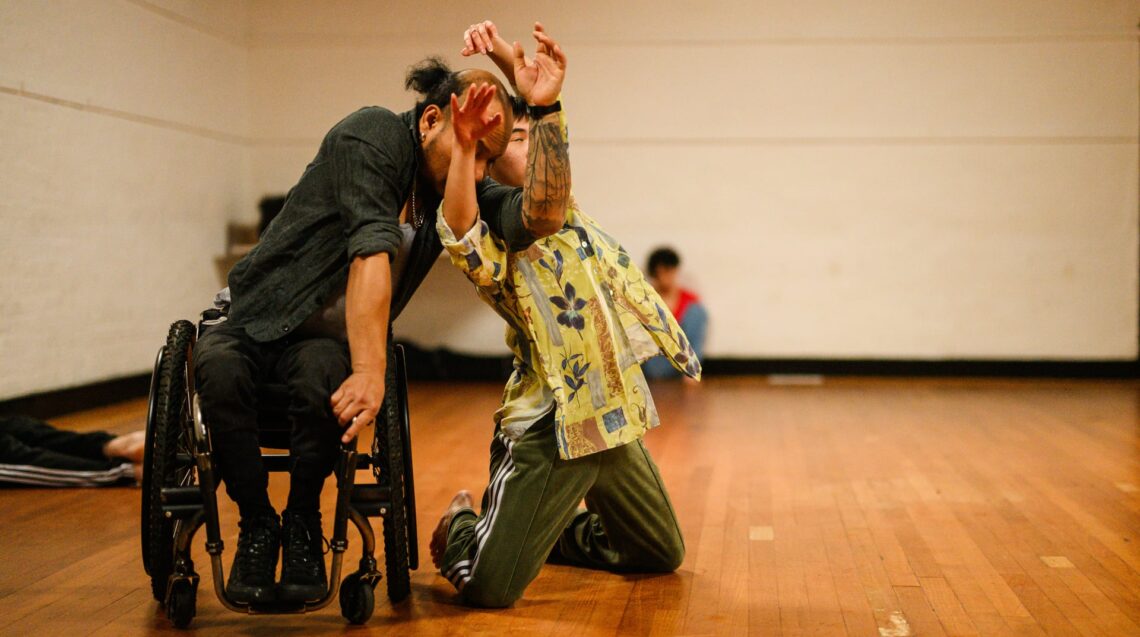
Two dancers tangled in contact. On the left, British-Cambodian wheelchair dancer Nadenh leans towards his left wheel and braces himself with his right and on his brakes. He curves his elbow into the shoulder of Emily, a East Asian woman, who kneels to his side.
Growing throughout the week
Speaking from a personal perspective, teaching in London was a bucket list item. I was very apprehensive on the first day because of the unknown; who will be dancing with us and how the material we had constructed would be received. However, the incredible opportunity to teach for the whole week allowed us to settle and I felt the difference from the beginning to the end of the week was huge. I was able to describe things in more detail, work on my use of language and explanations as well as find new ways to approach the speech within lead improvisation.
The energy bubbled throughout the week. Ideas and movement perspectives, new translations and most importantly, people enjoying moving together. A highlight for me was and will always be the people. The people we are lucky enough to move and share the practice with. Through the inquisitive nature of engaging with the material in the class, it was clear to see everyone embarking on the path of discovery throughout.
Nadenh and I have been dancing together, performing together, travelling together, teaching together for over a decade now and it is the greatest privilege to teach with him and share our practice at this level with so many amazing people.
Keep up to date
We will be sharing more regularly opportunities to dance with us via our monthly newsletter
Sign up and stay in touch