Listen to this news item via Soundcloud
A leadership development opportunity for Deaf, Disabled and neurodivergent mid-career arts professionals
We’re looking forward to welcoming a new Future Leader in May 2027, for a 12-month contract running until 2028.
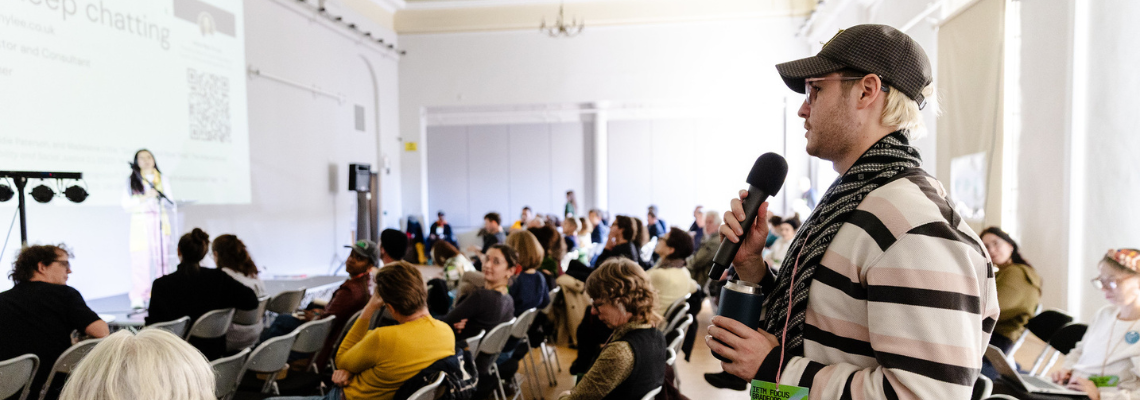
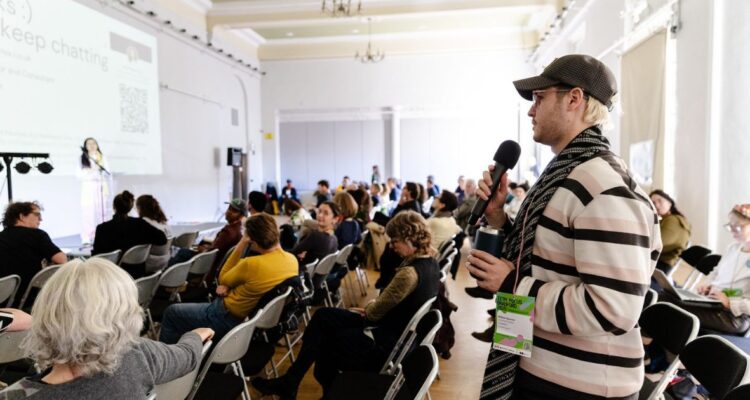
Future Leader Will at IETM - the International Network for Contemporary Performing Arts. Will, a white disabled person, stands and speaks into a microphone, asking a question to a full-room during a presentation session.
About Future Leaders
At Stopgap, we’re opening doors for the next generation of Disabled leaders, providing a supportive, inclusive space to grow, collaborate, and develop leadership skills.
Future Leaders offers paid positions for Disabled professionals at the start of their leadership journey. You’ll gain hands-on experience, work with a diverse range of people, and be guided by an experienced Stopgap mentor every step of the way.
Plus, our Future Leaders Coordinator will ensure you feel supported, valued, and empowered throughout the programme.
Who we're looking for
We are recruiting for the role of Assistant Producer
We’re seeking a passionate and driven individual who identifies as Deaf, Disabled or neurodivergent to join our Future Leaders programme as Assistant Producer. You will work alongside fellow Future Leader: Assistant Artistic Director and collaborate on two major projects during the year.
You will be mentored by Stopgap’s Executive Producer, Lucy Glover and work closely with Co-Artistic Directors Lucy Bennett and Laura Jones, as well as getting to know the team and our collaborators.
Discover more about the role and level of experience required by looking through the recruitment packs below.
BSL Call out - Interpreter Marcel Hirshman
How to Apply
Please complete the Typeform application (in either written or recorded formats) by Monday 9 November at 10am.
Below are a list of questions asked in the application to help you prepare your responses. There is also further application guidance below.
Please also complete this Equal Opportunities Monitoring form.
Contract Overview
Minimum requirements for this role:
- You must identify as Deaf, Disabled or neurodivergent
- You must have the right to work in the UK
- You must have 3 years of experience in a similar or transferable field of expertise
Salary: £18,000 (£30,000 full time equivalent)
Working hours: 22.5 hours per week (3 days)
Contract: One-year fixed term, with a one-month probation period
Start Date: May 2027
Location
- Stopgap’s office base is Farnham Maltings, Surrey. With regular use of studio spaces across Surrey and Hampshire.
- Applicants must be willing and able to commute to and around Surrey.
- Applicants may have the opportunity to travel to events or on tour nationally and internationally.
- Some remote working is available.
Examples of Work
During your time with Stopgap, you will be working on exciting activities including:
- Working towards Stopgap’s 30th anniversary.
- Co-ordinating our touring productions RO-TES-រទេះ (outdoor) and Lived Fiction (indoor) nationally and internationally
- Assisting the production of new work; working on projects from conception to delivery ensuring smooth project management and inclusive practices
- Taking part in strategic meetings with key stakeholders, including Arts Council England, British Council, fellow National Portfolio Organisations, and industry leaders
- Supporting with fundraising strategies and initiatives, contributing to the company’s long-term sustainability and growth
Application Guidance
The recruitment packs share more information about what sort of responses we are looking for to the application questions.
This is our first time trialling Typeform for a job application, so please do get in contact if you come across any issues. We know that it can be useful to know the questions that the application will ask, so they are available in the attached word document .
There are multiple options to respond with via the Typeform:
- You can respond to the questions by writing – please limit your written responses to the max. word limits provided.
- You can also submit a video or audio response of up to five minutes; again please follow the maximum time limit provided. The in-app option only allows up-to 2 minutes, but you can submit pre-recorded videos or audio recordings instead (each a maximum of 500MB in size).
If you prefer, you can submit a word document application instead, please email this, along with your CV to Future Leaders Coordinator Amy Owen.
A note from Stopgap on the use of AI in applications:
We understand that AI tools can support application processes. While we don’t prohibit the use of generative AI, we do encourage you to use it thoughtfully. AI generated text can sometimes feel impersonal, and it may not fully reflect your voice and experiences. We are most interested in your words, your passion and your perspective. If you do use AI, please review and personalise it to ensure it truly represents you.
Application Top Tips
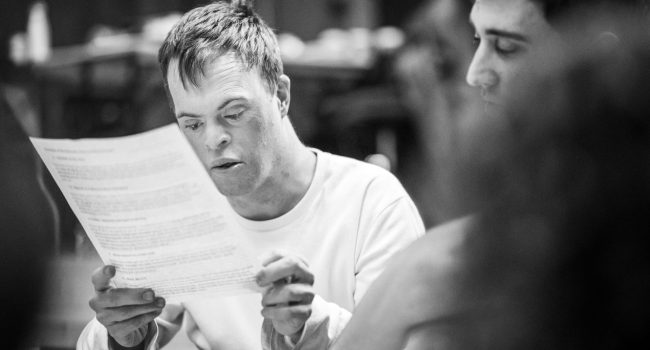
In this blog, we share our top-tips and guidance for approaching job applications and interviews!
Read or listen to the blogInterview Information
Initial Interviews: Online on Monday 7 or Tuesday 8 December
Second Interviews: Taking place in person in Farnham on 14 or 15 December
Reasonable travel costs to attend the interview will be covered and agreed on in advance.
Interview questions and task instructions will be provided in advance.
How we define Deaf, Disabled and neurodivergent
We use the terms Deaf, Disabled and neurodivergent to describe all people who face disablist, audist, neuronormative, and ableist barriers and discrimination.
As part of Future Leaders, we want to work with people who have experienced these barriers, and work with people who self-define as Deaf, Disabled and/or neurodivergent. We will never ask for any “proof” or “evidence”, and understand informed self-diagnosis to be valid.
We use identity-first language (e.g. “Disabled artist” rather than “artist with a disability”) in line with the social model of disability, which understands disability as created by a combination of socially constructed barriers, rather than solely by a person’s impairment or difference.
These terms are broad and intentionally inclusive: covering physical, sensory, learning and mental health-related access needs, as well as neurodevelopmental conditions such as Autism and ADHD, and learning difficulties such as dyslexia.
We also recognise that language is not fixed. Terms shift over time, mean different things to different people, and individuals may describe themselves differently to how we describe them collectively here. Where we can, we will follow the preferences of the people we’re working with directly.
Get in Touch
If you have any questions or require any adjustments to make the application process more accessible, please get in contact: